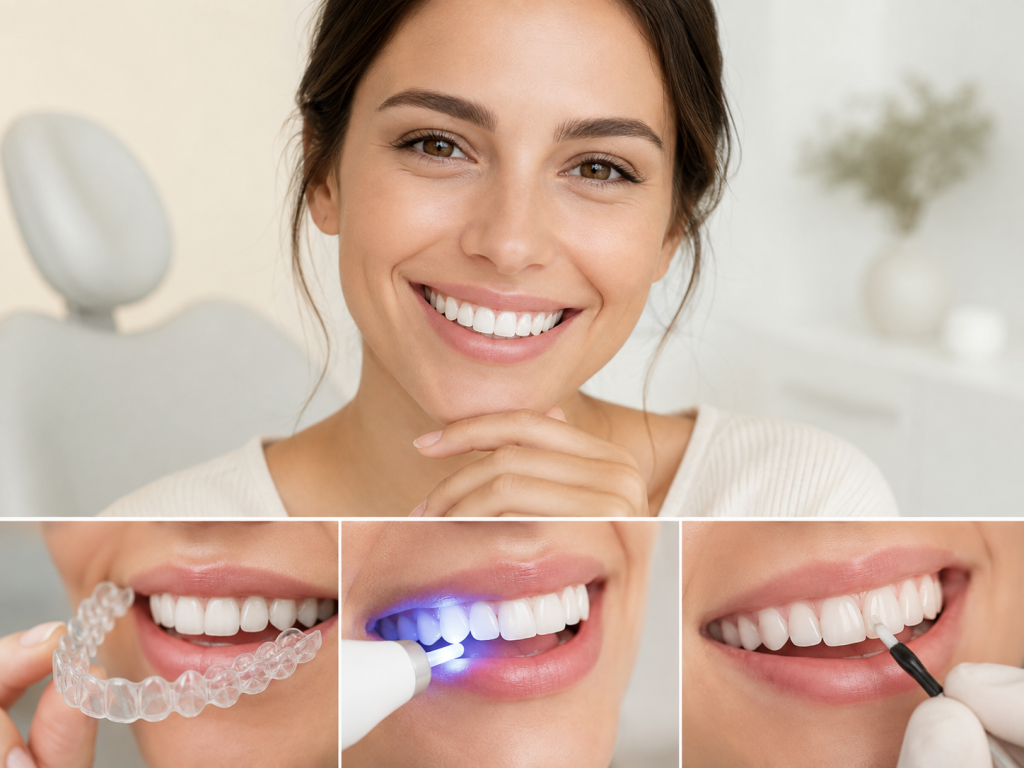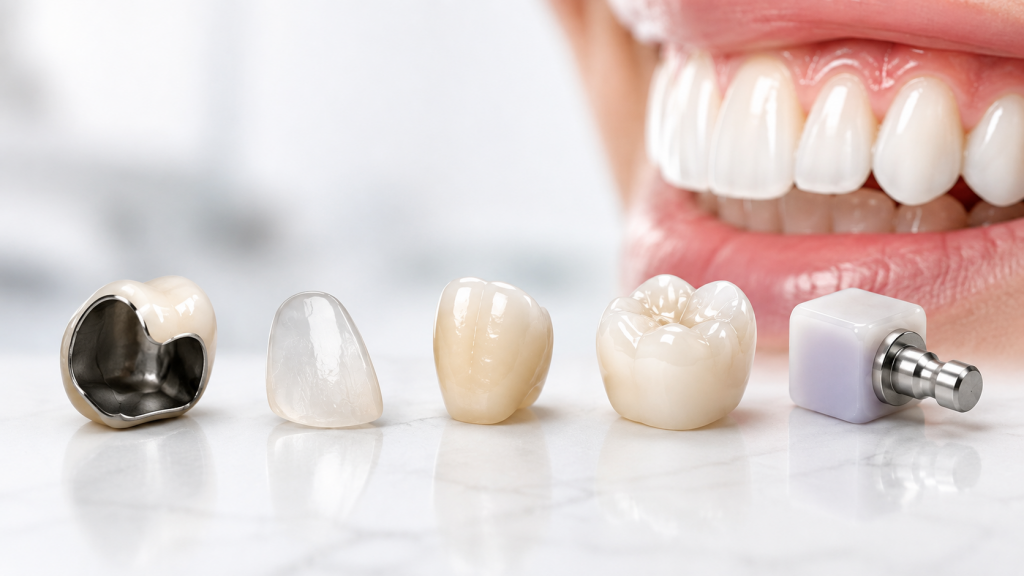
Veneers, crowns, inlays and other esthetic restorations can be made from very different materials. To a patient they may all look simply “tooth-colored”, but their strength, translucency, bonding behavior, repairability and required tooth preparation can vary considerably.
That is why there is no single dental ceramic that is best for every case. Modern restorative dentistry works with several material families and selects between them according to the tooth, the remaining enamel, the esthetic objective, the bite and the long-term maintenance plan. The 2026 supplement of The International Journal of Esthetic Dentistry devoted to restorative biomaterials emphasizes this same idea: material selection should be case-specific rather than trend-driven.
This article reviews the evolution of dental ceramics and restorative materials and explains the main options used today, from feldspathic porcelain and lithium disilicate to zirconia and polymer-infiltrated ceramic networks.
How dental restorative materials have evolved
The history of esthetic restorative dentistry is not a straight line from an “old” material to a single “new” one. It is a progression in which each generation solved some limitations while introducing new trade-offs.
Metal-ceramic restorations: strength with a tooth-colored exterior
Porcelain-fused-to-metal restorations became an important solution because a metal framework could provide structural support while porcelain reproduced a tooth-colored surface. They were highly influential in crown and bridge dentistry, although masking the underlying metal and creating space for both framework and porcelain could require more tooth reduction than many contemporary adhesive approaches.
Adhesive dentistry and feldspathic porcelain
The development of enamel bonding and etched porcelain changed the possibilities for conservative esthetic treatment. Feldspathic porcelain became especially important for thin veneers because of its optical depth and translucency. Adhesive techniques allowed clinicians to preserve more enamel when the case was suitable.
CAD/CAM, glass-ceramics and zirconia
Digital design and computer-aided manufacturing expanded the material palette. Lithium-disilicate glass-ceramics offered a combination of esthetics, adhesive bonding and improved mechanical performance, while zirconia brought very high strength to indications where load is a major concern. Newer translucent zirconias have improved esthetics, although strength and translucency still need to be balanced according to the restoration.
Resin-matrix and hybrid CAD/CAM materials
More recent CAD/CAM materials include resin nanoceramics and polymer-infiltrated ceramic networks (PICN). These are not identical to traditional ceramics: they combine a ceramic phase with a polymer phase to modify stiffness, machinability and repair behavior. They expand the restorative toolbox rather than replacing glass-ceramics or zirconia.
The main types of dental ceramics and restorative materials used today
Current reviews commonly group chairside CAD/CAM materials into glass-matrix ceramics, polycrystalline ceramics and resin-matrix materials. Direct composite is not a ceramic, but patients often compare it with ceramic options, so it is useful to include it in the same decision framework.
Direct composite resin
Composite resin is placed and sculpted directly on the tooth and polymerized with a curing light. Its main advantages are conservatism, repairability and the possibility of making small changes in one visit. It is particularly useful for additive corrections, small fractures, diastema closure and cases where preserving tooth structure is a priority.
Compared with ceramics, composite generally requires more maintenance because it can lose gloss, wear or stain over time. The exact longevity depends on the size and location of the restoration, the patient’s habits and the quality of maintenance.
Feldspathic porcelain
Feldspathic porcelain is valued for its highly natural optical behavior. It can reproduce translucency, brightness and subtle color effects extremely well, which makes it especially attractive for thin anterior veneers when there is sufficient enamel for predictable bonding.
Its limitation is lower fracture resistance compared with stronger glass-ceramics and zirconia. For that reason, case selection, occlusion and the amount of available enamel are particularly important.
Lithium disilicate glass-ceramic
Lithium disilicate is one of the most widely used glass-ceramics in modern restorative dentistry. It combines good optical properties with substantially greater strength than traditional feldspathic porcelain and can be adhesively bonded. Depending on the case, it may be used for veneers, inlays, onlays, partial restorations and single crowns.
Its versatility is one reason it is frequently considered when the clinician needs a balance between esthetics, conservative preparation and mechanical resistance.
Zirconia
Zirconia is a polycrystalline ceramic and is among the highest-strength dental ceramics used clinically. It is especially useful when the restoration must tolerate high functional loads, when there is limited restorative space, in many posterior indications and in implant-supported prosthodontics.
Different zirconia generations have different levels of translucency and strength. Highly translucent zirconia can provide improved esthetics, but material selection should still consider the restoration design, thickness, location and occlusal forces.
PICN and so-called hybrid ceramics
Polymer-infiltrated ceramic network materials combine an interconnected ceramic network with a polymer phase. They are often marketed as “hybrid ceramics”, although from a materials-science perspective they belong to resin-matrix ceramic materials rather than conventional all-ceramic systems.
They are designed to offer easier milling and a modulus of elasticity closer to dental tissues than many traditional ceramics. Clinical evidence is promising for selected indirect restorations, but the long-term evidence base is smaller than for established materials such as lithium disilicate or zirconia.
Dental ceramics comparison: what changes from one material to another?
| Material | Main advantage | Typical use | Main limitation |
| Direct composite | Conservative and easily repairable | Small esthetic corrections, additive restorations, repairs | More maintenance and lower wear/color stability than ceramics |
| Feldspathic porcelain | Excellent translucency and optical detail | Thin anterior veneers | Lower fracture resistance; careful case selection |
| Lithium disilicate | Balance of esthetics, bonding and strength | Veneers, inlays/onlays, partial restorations, many single crowns | Requires appropriate thickness and bonding/restoration design |
| Zirconia | Very high mechanical strength | Posterior crowns, bridges in selected designs, implant restorations | Bonding and translucency differ from glass-ceramics; generation matters |
| PICN / resin-matrix ceramic | Machinability and intermediate stiffness | Selected CAD/CAM indirect restorations | Less long-term clinical evidence than established ceramic systems |
How does a dentist choose the right ceramic?
The material is chosen after the treatment objective has been defined. The same material may be an excellent choice for one tooth and a poor choice for another.
- Remaining healthy enamel and dentin: adhesive restorations behave differently depending on the available substrate.
- Position of the tooth: anterior teeth and posterior teeth face different esthetic and mechanical demands.
- Occlusion and bruxism: heavy loading can change the preferred material and restoration design.
- Color of the underlying tooth or abutment: some materials mask discoloration better than others.
- Restoration thickness and available space: each ceramic has minimum design requirements.
- Repairability and future maintenance: some materials are easier to adjust or repair than others.
- Esthetic expectations: translucency, texture and color integration can be decisive in highly visible areas.
How digital dentistry changed ceramic restorations
Intraoral scanning, digital design and CAD/CAM manufacturing allow restorations to be planned with precise control over thickness, shape and occlusion. Digital workflows do not make every material equivalent; instead, they allow clinicians and laboratories to work more predictably with a wider range of materials.
The current CAD/CAM landscape includes feldspathic and leucite-reinforced ceramics, lithium-(di)silicate materials, zirconia-reinforced lithium silicates, different generations of zirconia, PICN and resin-based blocks. A recent 2026 review highlights that the breadth of these options makes correct material selection more important, not less.
Which dental ceramic is best?
There is no universal answer. For a thin veneer on a highly visible front tooth, optical properties and enamel bonding may be the priority. For a posterior crown under high load, strength and restoration design may carry more weight. For a small additive change, direct composite may preserve more tooth structure and remain easy to repair.
The best material is therefore the one whose biological, mechanical and esthetic properties match the needs of that specific tooth and patient.
Dental ceramics and esthetic restorations at Clinic Veres
At Clinic Veres in Valencia, material selection is part of the diagnosis and treatment planning process. We assess the condition of the tooth, remaining structure, bite, esthetic goals and maintenance needs before recommending a restorative option.
Frequently asked questions about dental ceramics
Is zirconia better than lithium disilicate?
Not in every situation. Zirconia generally offers higher mechanical strength, while lithium disilicate offers excellent esthetics and predictable adhesive bonding. The better choice depends on the tooth, restoration design, esthetic demand and bite.
What is the most natural-looking dental ceramic?
Feldspathic porcelain and glass-ceramics such as lithium disilicate can reproduce enamel-like translucency very well. The final appearance also depends on thickness, laboratory characterization, underlying tooth color and the clinician’s preparation and bonding strategy.
Are hybrid ceramics the same as traditional ceramics?
No. PICN and related resin-matrix materials contain both ceramic and polymer phases. They behave differently from glass-ceramics and zirconia and should be selected for specific indications.
Can dental ceramics be used if I grind my teeth?
Sometimes, but bruxism changes the risk assessment. The restoration design, material, occlusal management and possible use of a protective splint may all need to be considered before treatment.